


Many cycling nerds will be familiar with Robert Penn’s book It’s All About the Bike. Arboreally minded readers might also have read his next title, The Man Who Made Things Out of Trees. In it, Penn fells an ash tree to see how many things he can obtain from it. Being bike obsessed, one of the first people he contacted was fellow cyclist, engineer, and furniture designer, Andy Dix. Aiming to see if they might be able to fashion a bike from part of his haul of timber, after a bit of investigation, the pair instead settled on a desk. However, the idea of creating a bike from the material stuck with Dix.
Left to germinate for a few years, the final result of that request is Twmpa Cycles. Based in Hay-on-Wye and named after a nearby Welsh peak, the firm now creates bespoke gravel bikes from locally sawn ash.
“Andy is an engineer by training,” explains Twmpa co-owner Miguel Ferros. “But he’s been using this material for 20 years”.

“The author Robert Penn had asked him whether he could build a bike made from wood for a book he’d been commissioned to write. In the end, they settled on a desk. However, eventually, Andy made the bike anyway. I came into the story when Andy turned up on a Sunday ride on this wooden bike. It looked amazing. And when he still dropped us on the hills, I realised it must be quite fast as well”.
Describing the ride of an ash bike as akin to the combination of smoothness over jarring terrain and stiffness when pedalling provided by steel frames, gravel seemed a natural forum for these qualities.
“Once you ride it, you realise how comfortable it is”, says Ferros. "So we thought, this really is an excellent material for gravel and all-road riding”.
Obviously, not all woods are suitable for making bicycles. Sawn three miles from Twmpa’s workshop and sourced in Berkshire, ash possesses the exact properties required.
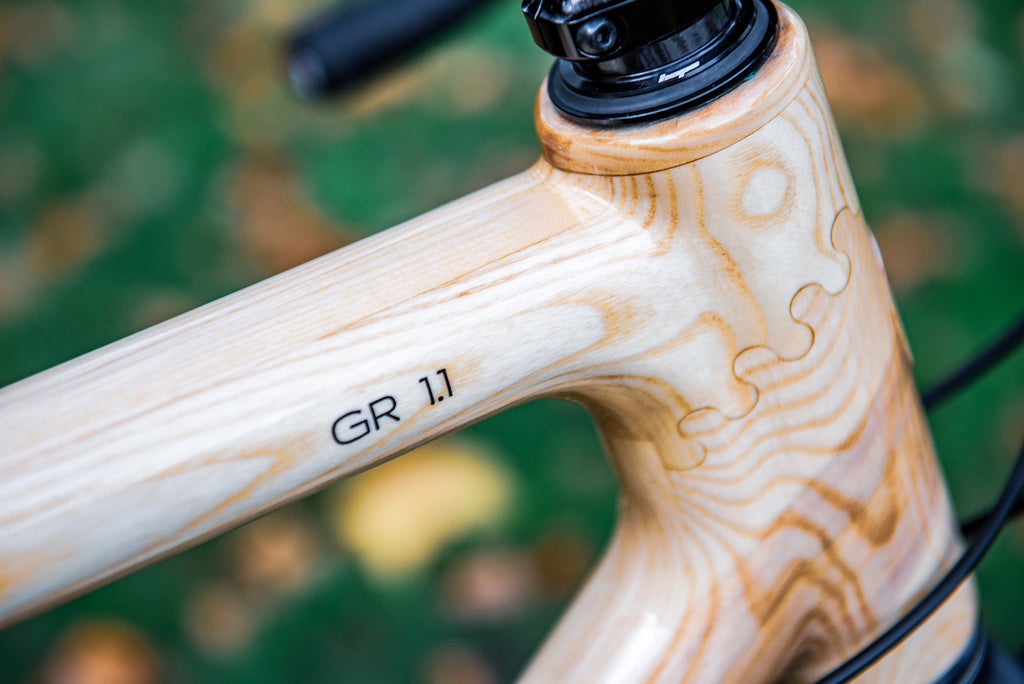 “The reason it works in a frame is the same reason it’s used in tool handles and cricket bats,” explains Ferros. “It’s very resistant to impact and very strong. Yet, at the same time, it also takes vibration away. Imagine a pickaxe with a carbon fibre handle. Using it to hit something hard would be very, very painful”.
By contrast, an ash handle will soften the impact, possesses an excellent strength to weight ratio, and isn’t brittle.
“At the moment, we’re not pushing the sustainability angle too hard, as we’re still adding other things to the frame”, says Ferros. “But ash is still far more sustainable than any other material”.
 Despite being more associated with craft than technology, Twmpa believes using wood might also help them overcome one of the key hurdles that trips up smaller frame builders. Currently, around a week of labour goes into each Twmpa frame. However, most elements are CNC machined, so assembling a wooden frame could easily become far more efficient than using a lugged or brazed construction. Allowing the business to overcome the scalability problem, this realisation was essential to Ferros’ and Dix’s decision to found the company.
A second key benefit of using wood is that the firm’s designs can easily be adapted to accommodate custom geometries. “We have off-the-shelf frames, but if you want a custom frame, we just ask you to send your fit data”, says Ferros.
“Unlike carbon, where you have to create new moulds, and unlike metal, where it becomes a completely hand-built process, we can reprogram the computer, and the CNC machine will take care of the rest”.
The precise work of these CNC machines is particularly noticeable in the beautifully tight jigsaw-like joints that connect the frame’s main tubes. Varnished on the outside and hollow inside, each frame typically weighs between 1.7kg and 2.0kg, depending on the size.
Tested the same as steel or carbon 
Working with such an unconventional material means many riders will wonder about durability. “That’s where Andy’s engineering expertise comes in,” says Ferros. “Our production frames have been engineered and then fully tested to ISO standards, so we know they’re strong enough”.
Experimented with extensively on all types of terrain, they’re also impervious to the weather, and if they are damaged in a crash, they can usually be refinished or repaired. Allowing the firm to offer a 10-year warranty on its frames, they don’t expect any of them to be coming back.
Founded just two years ago, launching a company during the pandemic has been challenging. However, Rouleur Live in London offered many prospective riders a chance to see the bikes for the first time. Alongside the standard GR 1.1, the firm also exhibited the C-Zero. Fitted with RockShox’ gravel-specific suspension fork and showing what can be achieved when pushing the bike’s specification towards its limit, it nevertheless avoids any carbon components.
 “We want to build a sustainable business, and the C-Zero is an example of a high-end bike built with no carbon fibre,” says Ferros. Created to spotlight the ubiquity of energy-hungry and hard to recycle carbon fibre, it highlights the industry’s challenge in reaching carbon neutrality.
Also at the show was Twmpa’s E-Flow which features an incredibly neatly integrated mid-motor. Produced by UK firm FreeFlow Technologies, the same system will be included on the firm’s next project. This will see them applying the same production materials and techniques to the problem of creating a sustainable city bike.
Offering the possibility of a utilitarian bicycle made from sustainable materials and using electrical expertise that’s similarly homegrown, the firm expects to launch both versions of its city bike early next year.


